
Last Tuesday, a homeowner in Cranford called us in a panic. “My roof is leaking into my bedroom. I need a roofer right now.”
When we got there, his roof was fine. Perfect, actually. Installed three years ago with a 25-year warranty. Zero damage.
The brown water stain spreading across his bedroom ceiling? That was coming from his chimney. Specifically, from the flashing where his chimney meets the roof.
He’d already called two roofing companies. Both quoted him $8,000-$12,000 for roof repairs he didn’t need.
The Most Expensive Misdiagnosis in Home Repair
We see this every December. The first big freeze hits, then it rains, and suddenly brown water stains appear on ceilings near chimneys. Homeowners immediately think “roof leak” because that’s where water damage usually comes from.
But if the stain is within 6 feet of your chimney, the roof probably isn’t your problem.
Your chimney flashing is.
What’s Actually Happening (And Why It Happens in Winter)
Chimney flashing is the metal sheet installed where your chimney penetrates the roof. Think of it as a metal skirt around the base of your chimney. Its entire job is to create a waterproof seal between the chimney masonry and your roof.
Here’s what kills it:
1. The caulking fails first
The caulk sealing the flashing to the chimney wears away. In New Jersey, our freeze-thaw cycles are brutal. Water gets in, freezes, expands, and cracks the seal. Now you’ve got a gap.
2. Winter makes it worse
During summer, that gap might not matter much. But winter brings ice dams, heavy snow sitting on your roof for weeks, and rain that freezes and thaws repeatedly. All that moisture finds the gap.
3. The water runs down inside your wall
Once water gets past the flashing, it doesn’t drip straight down through your ceiling. It runs down the inside of your wall cavity, traveling along studs and insulation until it finds the path of least resistance. That might be 6 feet away from your chimney.
That’s why homeowners look at the stain and think “roof leak.” The water shows up far from where it’s actually getting in.
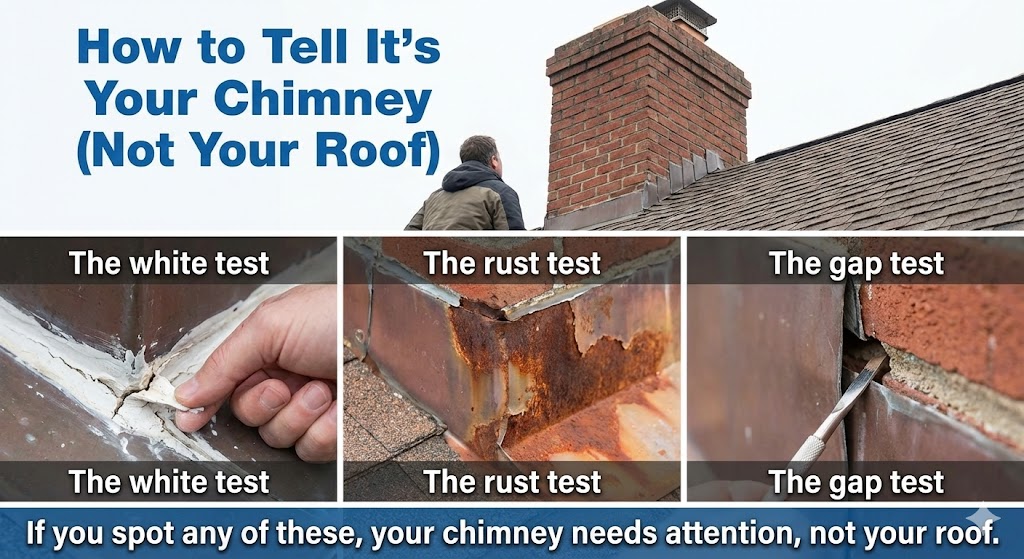
How to Tell It’s Your Chimney (Not Your Roof)
Walk outside and look at your chimney. You’re looking for:
The white test: Run your finger along where the flashing meets the chimney. If the caulk is cracked, crumbly, or you can peel it away easily, water is getting in.
The rust test: If your chimney flashing is rusty or corroded, especially at the seams, it’s compromised.
The gap test: Can you see ANY gap between the metal flashing and your chimney brick? Even a hairline crack is enough for water to enter.
If you spot any of these, your chimney needs attention, not your roof.
“Can’t I Just Recaulk It Myself?”
You can.
And if you catch it early enough, that might buy you a year or two.
But here’s what we find when we fix chimney flashing the right way:
- The flashing itself is often corroded beneath the caulk
- The mortar around the flashing has deteriorated
- Water has already damaged the wood framing behind the chimney
- The chimney crown (the concrete cap at the top) is cracked, making the flashing problem worse
That $15 tube of caulk might stop the immediate drip. But next winter, when ice builds up and really tests that seal, you’ll be back in the same spot. Except now the water damage has spread.
The Winter Timeline (Why This Gets Expensive Fast)
Week 1: You notice the stain. It’s small. You put a bucket there and wait for spring to deal with it.
Week 4: The stain has grown. You can smell mustiness. That’s mold starting.
Week 8: The ceiling drywall is soft now. The insulation in your wall is soaked. If it’s cold enough, that wet insulation isn’t doing anything—your heating bill jumps.
Week 12: It’s March. You call someone. They open up the wall and find:
- Destroyed drywall: $800-1,500
- Ruined insulation: $600-1,000
- Mold remediation: $2,000-4,000
- Damaged wood framing: $1,200-3,000
- The actual chimney repair: $1,800-4,000
Total: $6,400-13,500
Or you can handle the flashing now for $1,800-3,500 and avoid all of that.
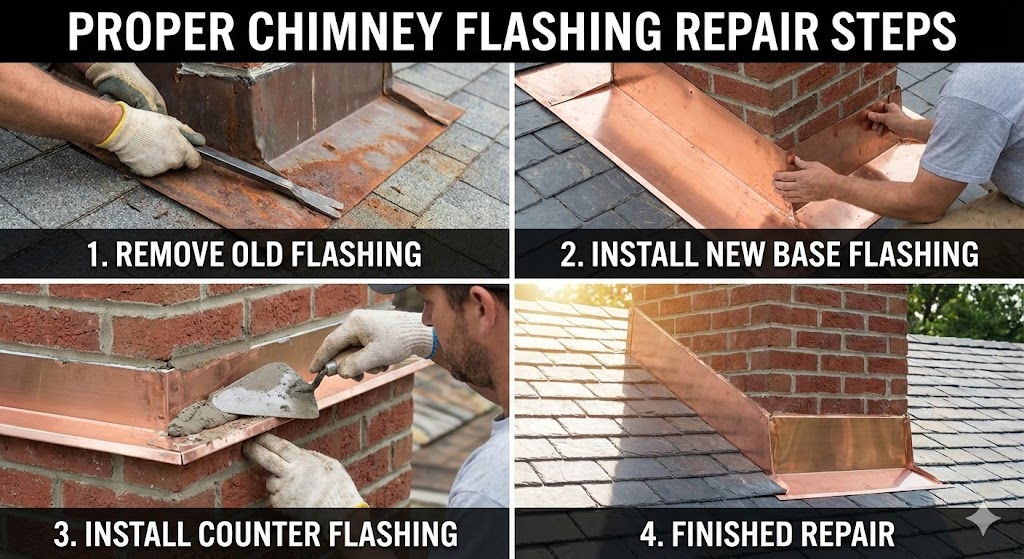
What Proper Chimney Flashing Repair Actually Involves
We don’t just recaulk. When we fix chimney flashing, here’s what happens:
- Remove the old flashing – All of it. Not just the visible parts.
- Inspect the chimney structure – Check for cracks in the mortar, deteriorating brick, and damage to the chimney crown.
- Repair any masonry damage – This is crucial. New flashing won’t help if the chimney itself is compromised.
- Install new flashing properly – This means counter-flashing that tucks into the mortar joints, not just surface-mounted metal.
- Seal it correctly – Commercial-grade sealant designed for chimney applications, not hardware store caulk.
The owner is present for every one of these jobs. Because if your flashing repair fails next winter, it’s usually because someone skipped step 3 or 4.
When It’s Actually Both (Chimney AND Roof)
Sometimes it is your roof. About 15% of the time, homeowners have two problems:
- Failing chimney flashing
- A separate roof leak nearby
The way to know: water stains in multiple locations, or stains that appear far from any chimney. If you’ve got brown stains in three different rooms, your roof probably does need attention.
Our roofing team handles both. We inspect the entire system—chimney, flashing, and roof—so you know exactly what needs fixing.
“How Long Will This Take to Fix?”
Most chimney flashing repairs take 1-2 days, depending on weather and the extent of damage.
If we find additional chimney problems (like a deteriorated crown or cracked masonry), add another day or two.
But here’s the thing: we can work in winter. As long as temperatures are above 25°F and it’s not actively precipitating, masonry work can be done. We don’t make you wait until April.
The Free Inspection Nobody Takes (Until It’s Too Late)
We offer free inspections. No strings, no pressure, no hidden diagnostic fees.
Most people see the brown stain, call a roofer, get a scary quote, and then… wait. They wait because $10,000 feels like something to save up for. Meanwhile, the actual problem—the flashing—gets worse every week.
If you’re in Union County, Essex County, Morris County, or anywhere else in our service area, the inspection takes 20 minutes. We’ll tell you:
- If it’s your chimney or your roof (or both)
- Exactly what needs to be fixed
- What it actually costs
- How urgent it is
No sales pitch. After 26 years, we don’t need to pressure anyone. The work speaks for itself.
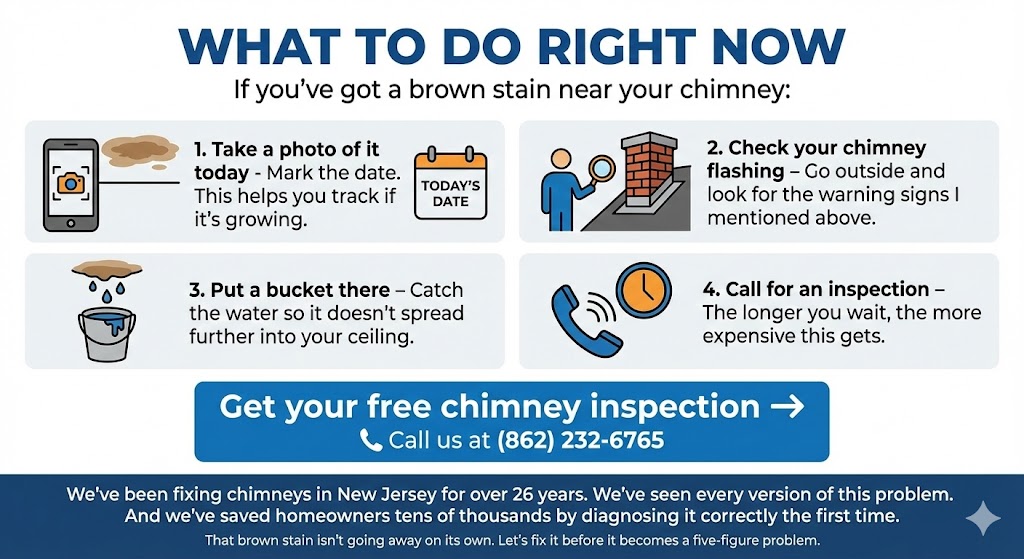
What to Do Right Now
If you’ve got a brown stain near your chimney:
- Take a photo of it today – Mark the date. This helps you track if it’s growing.
- Check your chimney flashing – Go outside and look for the warning signs I mentioned above.
- Put a bucket there – Catch the water so it doesn’t spread further into your ceiling.
- Call for an inspection – The longer you wait, the more expensive this gets.
Get your free chimney inspection →
Call us at (862) 232-6765
We’ve been fixing chimneys in New Jersey for over 26 years. We’ve seen every version of this problem. And we’ve saved homeowners tens of thousands by diagnosing it correctly the first time.
That brown stain isn’t going away on its own. Let’s fix it before it becomes a five-figure problem.
E-Pro Construction
Serving New Jersey since 1997
Licensed, Insured, Owner-Present on Every Job
