
A homeowner in Westfield called us in April with what he described as “a small crack in my foundation that got a little bigger over winter.”
When we arrived, the crack wasn’t small anymore. It was 3 inches wide in places. His basement wall was bowing inward. Water was seeping through. The structural engineer we brought in estimated $18,000 in repairs.
“It was just a hairline crack in October,” he told us. “I figured I’d deal with it when the weather got warm.”
That hairline crack cost him $18,000 because he waited five months.
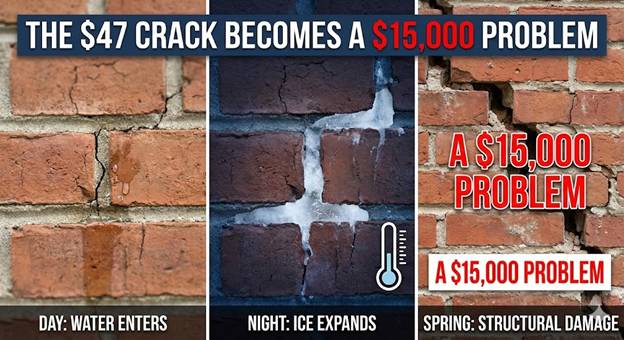
The $47 Crack That Becomes a $15,000 Problem
Here’s what most New Jersey homeowners don’t understand about masonry cracks:
They don’t just sit there waiting for you to fix them.
They’re actively getting worse. Every single day. And winter accelerates the damage by about 10x compared to summer.
That crack you’re looking at right now—the one that seems like no big deal? It’s collecting water. Tonight, when temperatures drop below freezing, that water will turn to ice. Ice expands with 9% more volume than water.
That expansion will push your crack wider.
Tomorrow it’ll rain again. More water gets in the now-wider crack. Tomorrow night it freezes again. The crack gets wider still.
This happens every single night from December through March. Sometimes twice a day if we get a thaw-freeze cycle.
By spring, your “small crack” has become a structural problem.
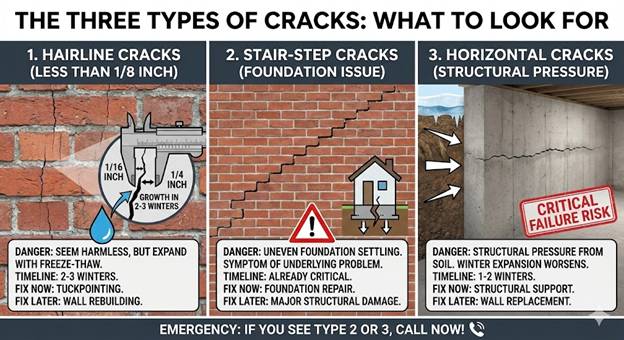
The Three Types of Cracks (And Which Ones Are Emergencies)
Not every crack is urgent. But most homeowners can’t tell the difference. Here’s what we look for:
1. Hairline Cracks (Less than 1/8 inch)
What they look like: Thin lines, usually in mortar joints or running vertically through brick.
The danger: These seem harmless. They’re not. In New Jersey’s freeze-thaw climate, a 1/16″ crack in October will be 1/4″ by March. That’s when water penetration really starts.
Timeline to crisis: 2-3 winters if left alone.
Fix now cost: $300-800 for tuckpointing
Fix in 2 years cost: $2,500-6,000 for wall rebuilding
2. Stair-Step Cracks (Following mortar joints)
What they look like: The crack follows the mortar lines between bricks, creating a stair-step pattern.
The danger: This means your foundation is settling unevenly. The crack is a symptom. The real problem is underneath.
Timeline to crisis: Already critical. These don’t wait.
Fix now cost: $2,500-8,000 depending on cause
Fix later cost: $15,000-35,000 (foundation repair, wall rebuild, water damage)
3. Horizontal Cracks (Running sideways across the wall)
What they look like: Horizontal lines, often in foundation walls or retaining walls.
The danger: These indicate structural pressure—usually from soil pushing against the wall. Winter makes this worse because frozen ground expands.
Timeline to crisis: 1-2 winters. These fail fast.
Fix now cost: $3,000-12,000
Fix later cost: $20,000-50,000 (wall replacement, drainage system, interior damage)
If you’ve got type 2 or 3, don’t wait for spring. Call now.
The Physics of Why Winter Destroys Masonry
Water is the enemy. Specifically, the freeze-thaw cycle.
Here’s the science:
- Water enters the crack – Rain, snow melt, morning dew. Masonry is porous. It drinks water like a sponge.
- Temperature drops below 32°F – That water freezes. When water freezes, it expands by 9% of its volume.
- The ice pushes outward – This expansion creates tremendous pressure—up to 2,000 pounds per square inch. Your mortar can’t withstand that. The crack widens.
- Temperature rises, ice melts – Now the crack is bigger. More water flows in.
- Repeat 40-60 times per winter – In New Jersey, we get frequent freeze-thaw cycles from December through March.
Each cycle, the crack gets worse. Not by a little. By a lot.
After one winter of this, that 1/16″ crack is now 1/4″. After two winters, it’s 1/2″ and pieces of your brick facing are falling off.
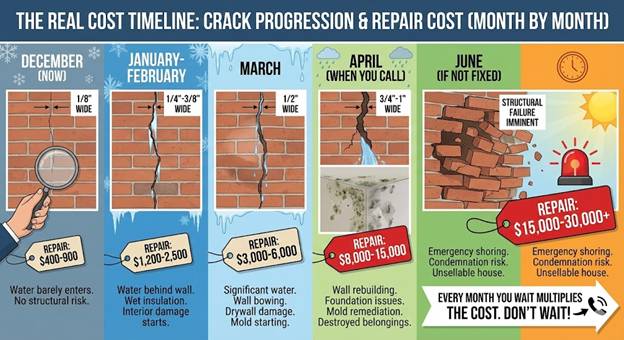
The Real Cost Timeline (Month by Month)
Let’s say you spot a crack in your foundation wall today—December 17th. Here’s what happens if you wait:
December (Right Now)
- Crack is 1/8″ wide
- Repair cost: $400-900
- Water can barely get in
- No structural risk yet
January-February
- Crack is now 1/4″-3/8″ wide
- Repair cost: $1,200-2,500
- Water is getting behind the wall
- Insulation is getting wet
- Small amount of interior damage starting
March
- Crack is 1/2″ wide in places
- Repair cost: $3,000-6,000
- Significant water penetration
- Wall may be bowing
- Interior drywall damage
- Mold starting
April (When You Finally Call)
- Crack is 3/4″-1″ wide
- Repair cost: $8,000-15,000
- Masonry wall needs rebuilding
- Foundation issues possible
- Interior water damage throughout winter
- Mold remediation needed
- Belongings in basement destroyed
June (If You Still Haven’t Fixed It)
- Structural failure imminent
- Repair cost: $15,000-30,000+
- Emergency shoring required
- Possible condemnation risk
- Can’t sell the house until it’s fixed
Every month you wait multiplies the cost.
“But Can’t I Just Fill It With Caulk?”
Please don’t.
We see this constantly. Homeowner spots a crack, runs to Home Depot, buys a $8 tube of concrete caulk, and fills the crack. Problem solved, right?
Wrong.
Here’s what actually happens:
- The caulk doesn’t bond properly – Masonry needs specific mortar mixes. Caulk doesn’t have the same properties. It’ll separate within weeks.
- You’ve trapped water behind it – The crack goes deeper than you can see. Water is already behind the wall. You just sealed it in, where it’ll freeze and do more damage.
- The crack will reappear – Usually 4-6 inches to the left or right of where you filled it. Because you didn’t address why the crack formed in the first place.
- You’ve made it harder to fix properly – Now we have to remove all that caulk, clean out the crack, AND fix the underlying issue.
Caulk might buy you 2-3 months. Then you’re back to square one, except the crack is worse.
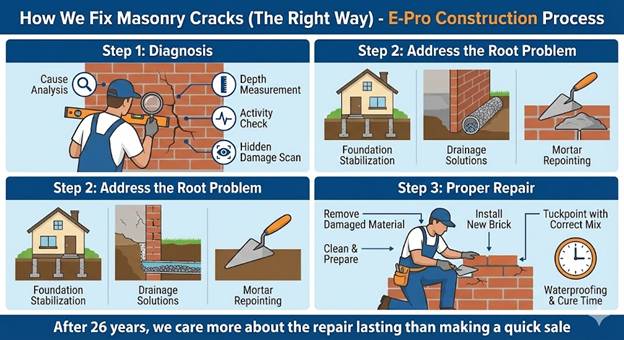
How We Actually Fix Masonry Cracks (The Right Way)
When you call E-Pro Construction about a crack, here’s what happens:
Step 1: Diagnosis
We don’t just look at the crack. We look at:
- What caused it (settlement, water pressure, structural issue)
- How deep it goes
- Whether it’s still active (growing) or dormant
- If there’s hidden damage behind the wall
The cause matters more than the crack itself.
Step 2: Address the Root Problem
If your crack is from foundation settlement, filling the crack does nothing. We need to stabilize the foundation first.
If it’s from water pressure behind the wall, we need drainage solutions.
If it’s from mortar deterioration, we need to repoint the surrounding area too.
Step 3: Proper Repair
For most cracks, this means:
- Removing damaged mortar and brick
- Cleaning the area completely
- Installing new brick if needed
- Tuckpointing with the correct mortar mix
- Waterproofing if appropriate
- Allowing proper cure time
We don’t rush it. Mortar needs time to cure properly, especially in winter. If temperatures are too low, we’ll tell you to wait—even though that costs us the job.
After 26 years, we care more about the repair lasting than making a quick sale.
The Winter Work Question
“Can you even do masonry work in December?”
Yes. With conditions.
We can work when:
- Temperatures are above 25°F
- It’s not actively raining or snowing
- We can protect the work area from overnight freezing
We can’t work when:
- It’s below 25°F
- Mortar won’t cure properly
- Conditions risk freeze damage to fresh repairs
For most of December through February in New Jersey, we have 2-3 workable days per week. We schedule around the weather.
What we won’t do: rush a job in bad conditions just to get it done. If the forecast is bad, we’ll reschedule. You want this fixed right, not fast.
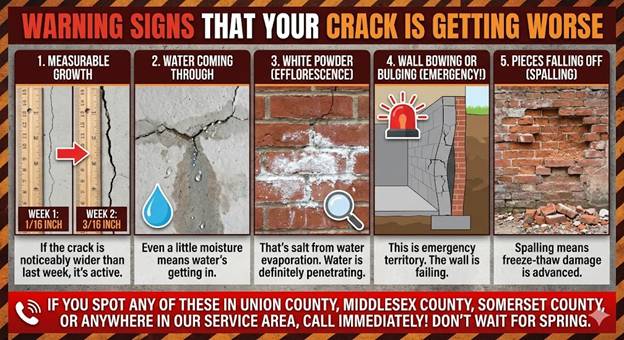
Warning Signs That Your Crack Is Getting Worse
Check your crack once a week. Take a photo with a ruler next to it for scale. If you see any of these, call immediately:
It’s growing measurably – If the crack is noticeably wider than last week, it’s active.
Water is coming through – Even a little moisture means water’s getting in.
You see white powder (efflorescence) – That’s salt from water evaporation. Water is definitely penetrating.
The wall is bowing or bulging – This is emergency territory. The wall is failing.
Pieces are falling off – Spalling (brick faces popping off) means freeze-thaw damage is advanced.
If you spot any of these in Union County, Middlesex County, Somerset County, or anywhere in our service area, don’t wait for spring.
The Three Most Common Mistakes
Mistake #1: “It’s been there for years, it’s fine.”
No. It’s been getting worse for years. You just haven’t measured it. Cracks don’t stay the same size. Physics doesn’t work that way.
Mistake #2: “I’ll deal with it when I sell the house.”
Home inspectors flag masonry cracks. Buyers will negotiate $10,000-20,000 off your asking price for a $3,000 repair. You’ll pay for it either way—except you’ll pay more later.
Mistake #3: “I got a quote, but it seems expensive.”
Expensive compared to what? Waiting until the wall collapses? Having $15,000 in water damage? Not being able to sell your house?
The expensive option is waiting.
What the Free Inspection Actually Tells You
We don’t charge for inspections. Here’s what you get:
- Honest assessment – Is it urgent? Can it wait? We’ll tell you.
- Root cause identification – Why did this crack form? If we don’t fix the cause, it’ll crack again.
- Real pricing – Not a ballpark. An actual quote based on what needs to be done.
- Timeline options – Can we do it now? Should you wait for better weather? We’ll lay it out.
- Prevention advice – What you can do to prevent future cracks.
The inspection takes 20-30 minutes. The owner is there. We’ve been doing this since 1997—we’ve seen every type of crack in every type of building across New Jersey.
Schedule your free masonry inspection →
Call (862) 232-6765
Do This Right Now
- Go look at your crack – Take a photo with a ruler or coin for scale. Note today’s date.
- Check the surrounding area – Are there other cracks nearby? Is the wall bowing?
- Look for water damage – Stains, efflorescence, moisture—these are red flags.
- Check it again next week – Has it grown? Even 1/16″ of growth in a week means it’s active.
- Call before it’s a crisis – The best time to fix a crack is when it’s still small.
Don’t wait for spring. Spring doesn’t fix masonry cracks. It just reveals how bad they got over winter.
E-Pro Construction
New Jersey’s Masonry Experts Since 1997
Licensed • Insured • Owner-Present on Every Job
Serving: Union, Essex, Morris, Somerset, Middlesex, Monmouth, Bergen, Hunterdon, Warren, Sussex & Passaic Counties